In short
Most used-car scams are old tricks in new listings. A deposit asked for before you have seen the car, a “private seller” who is really an unlicensed dealer, a stolen car wearing a copied identity, a flood-damaged vehicle with a washed title, or mileage that has quietly run backwards — every one of them can be screened for with the same habits: see the car, read the documents, run the VIN through official channels, and pay only in ways that can be traced — none of them conclusive on its own.
The deposit that buys nothing
The pattern: a well-priced car with good photos, a seller who cannot meet (“working overseas”, “about to deploy”, “the car is in storage”), and a request for a deposit or full payment to “hold” or “ship” it. The photos are usually lifted from a real ad — the listing-photo guide covers the reverse-image check that exposes borrowed pictures.
The tells are the urgency and the payment method. Requests for wire transfers, gift cards or payment-platform “friends and family” transfers are designed to be unrecoverable. Buying a car sight unseen carries substantial risk — consumer-protection checklists such as New Zealand’s describe it plainly — so view the car yourself or arrange an independent inspection before committing. And an unexplained demand for advance money combined with a refusal of any viewing is a serious warning sign: whatever the listing’s explanation, the combination is reason enough to walk away and keep looking.
Curbstoning: dealers posing as owners
Curbstoning is the trade’s name for an unlicensed dealer selling as a private individual — parking cars on verges and in supermarket lots with hand-written “For Sale” signs, or running several “private” listings from one phone number. It matters because private sales usually carry far fewer legal protections than dealer sales: New Zealand’s consumer checklist spells out that gap, and the same dealer-versus-private distinction shapes buyers’ rights in most markets.
How it surfaces: the title or registration is not in the seller’s name (“selling it for a friend”), the same mobile number appears across multiple listings, the meeting place is a car park rather than a home, and the seller knows little about the car’s history. NICB’s buying guidance recommends buying from reputable licensed dealers for exactly this reason — a licensed dealer has premises, a paper trail and a regulator. A curbstoner has a phone number that will be switched off next week.
VIN cloning and title washing
Two related tricks launder a bad vehicle’s paperwork. VIN cloning, described by the NICB, works like identity theft for cars: criminals copy the VIN from a legally owned vehicle, build a counterfeit VIN plate and forged documents, steal a matching vehicle, swap in the counterfeit plate, and sell the “clean” clone to an unsuspecting buyer. The giveaway is usually in the details — a VIN plate with disturbed rivets or the wrong typeface, documents that do not match the car’s age or colour, a title issued far from where the car has lived. The VIN guide shows where the plates should sit and what a decoded VIN should agree with.
Title washing takes a car with a damaging title brand — salvage, flood, rebuilt — and re-registers it in a jurisdiction that does not carry the brand forward. NICB describes how flooded cars get dried, moved and re-titled until the paperwork reads clean. The shared countermeasure for both tricks is running the VIN through official records before money moves. In the US, NMVTIS reports current title brands, salvage and total-loss records, and the latest reported odometer reading via approved providers, while NICB’s free VINCheck flags vehicles reported to participating insurers as unrecovered stolen or salvage/flood-damaged.
Neither check is a guarantee — VINCheck only sees what participating member insurers reported, and both check the number, not the car: a cloned VIN can return the legitimate donor vehicle’s clean history. A hit on either service ends the purchase, but a clean result is one input into the wider history check, not the whole of it — confirm the VIN plate, the certification label and the paperwork all belong to the physical car, and when the identity itself is doubtful, a professional inspection or official help is the route, not another lookup.
Odometer wind-back
Mileage is money, so mileage gets edited. Digital dashboards have not ended wind-back; they have moved it into software. The result is a car that reads low and wears high — seat bolsters, pedal rubber and steering wheel all telling a bigger number than the dash.
Detection is a comparison exercise. Texas DMV guidance lists the working checks: compare the odometer against the mileage printed on the title, against service records and inspection reports, and against the oil-change stickers left on door frames and windscreens; look at wear on pedals and seats; and watch for odometer “brands” on the title itself, which flag readings already known to be wrong. In the US, an NMVTIS report includes the latest reported odometer reading — a number that should be lower than what the dashboard shows today, not higher.
A mileage that dips between recorded events is a stop sign. A seller who cannot produce any paperwork trail at all is telling you the history is whatever they say it is.
Meeting and paying safely
Figure 1 · The safe sequence
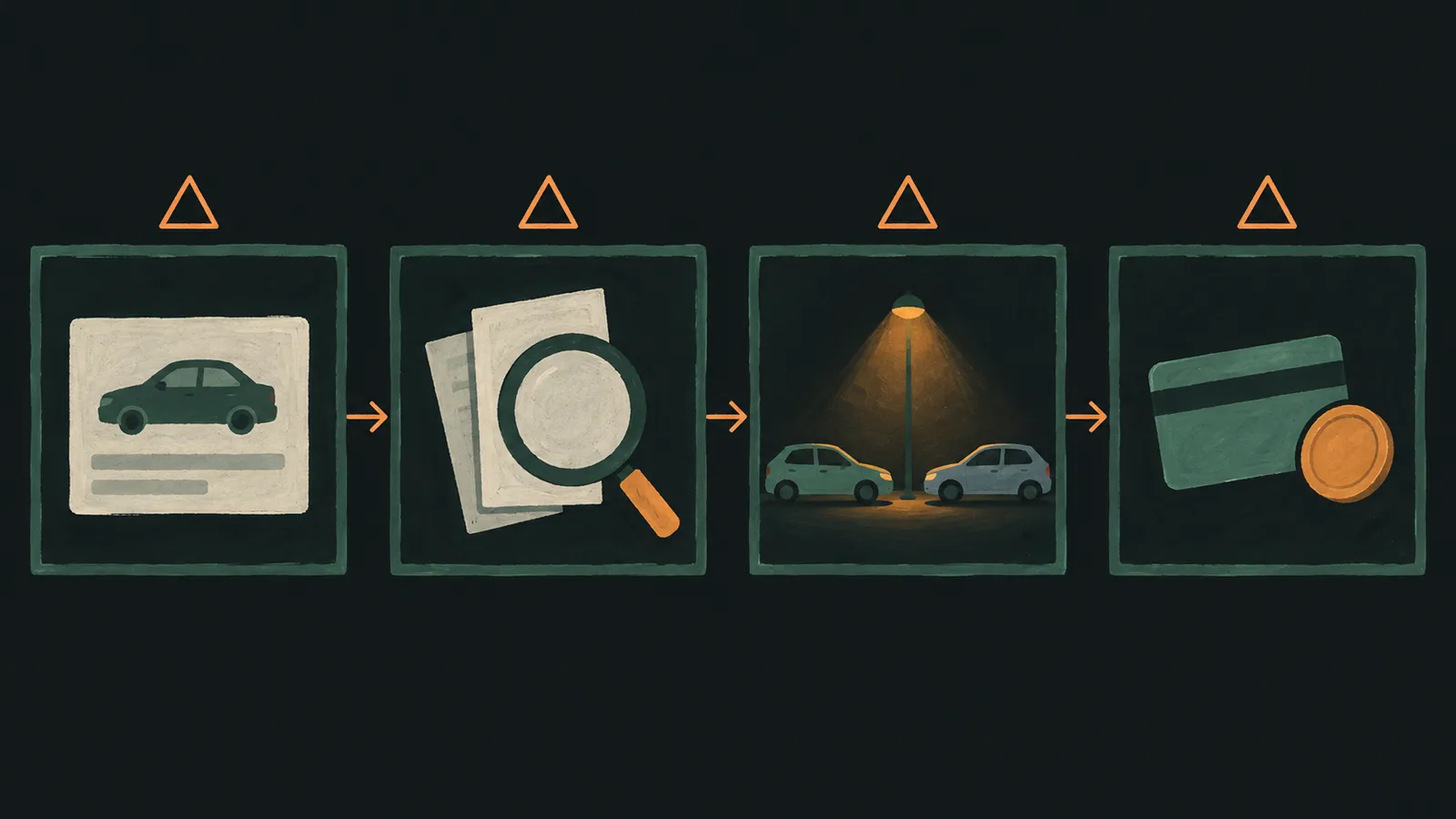
Physical safety first: meet in daylight in a public place, bring someone, and let the seller know a friend has the listing details — legitimate sellers are never offended by caution. Check that the person selling is the person on the title or registration; a name that does not match is curbstoning’s most reliable tell.
Money last, and traceably. The FTC’s used-car guidance tells buyers to get promises and out-the-door prices in writing — the private-sale version is a written receipt and a payment method that leaves a record. Bank transfer or a bank draft handed over at exchange keeps a trail; cash-in-an-envelope and “send the deposit now” do not. Never pay to “reserve” a car you have not seen, and treat any story that makes the car unavailable for viewing as the end of the conversation.
If you want a second set of eyes on the paperwork before paying, that is what the independent inspection step is for — a professional inspection catches what records miss.
If it goes wrong: who to tell
Act quickly and report through the channels that match the failure:
- Police — if the car may be stolen or cloned, or if you were threatened. A cloned car can be seized; the sooner it is reported, the clearer your position as a victim rather than a holder of stolen property.
- The platform — report the listing. Fraudulent sellers reuse accounts; reports get accounts and sister listings removed.
- Online fraud: in the US, report internet-driven car fraud to the FBI’s IC3 and to the FTC’s fraud reporting; dealer misconduct also goes to your state’s attorney general or motor-vehicle agency.
- Outside the US — national consumer-protection bodies and police handle equivalent complaints. In the UK, fraud reporting routes split by nation: Report Fraud took over from Action Fraud in December 2025 for England, Wales and Northern Ireland, while Scotland reports directly to Police Scotland. In New Zealand, the Consumer Protection channels apply.
Keep every artifact you can: the listing URL and screenshots, the seller’s contact details, message threads, payment records and the VIN. Complete evidence gives investigators more to work with, but report promptly even when some of it is missing — IC3 accepts reports with whatever information you can supply, and yours may still corroborate complaints from other victims. No report guarantees an investigation or a response; the decision sits with the agency either way.
Sources and what they cover
Sources last checked . Linked sources support the general claims beside them; none of them evaluates any specific listing or seller.
- US FTC: Buying a Used Car from a Dealer — written prices and promises, history reports and inspections before money moves.
- NZ Consumer Protection: Before buying a used car — the “sight unseen” warning and the dealer-versus-private protection gap.
- NICB: Buying a Used Vehicle — vehicle cloning and title-washing mechanics, and the protective checks NICB recommends.
- NICB VINCheck — the free theft and salvage indicator, limited to records reported by participating member insurers.
- NMVTIS consumer page — the federal title database: title brands, salvage and total-loss records, and the latest reported odometer reading via approved providers.
- Texas DMV: Odometer Brands — wind-back detection: title comparisons, service records, wear cues and odometer title brands.
- FBI IC3 — the US reporting route for internet-driven vehicle fraud.
- GOV.UK: Report Fraud service announcement — the City of London Police service that replaced Action Fraud for England, Wales and Northern Ireland from 4 December 2025; Scotland reports to Police Scotland directly.
Spotted an error? Tell us — include the page address and what looks wrong.