In short
A registration plate is an index into a government register, not a description of the car. Reading it well tells you the issuing jurisdiction and, in systems that embed one, a registration-era clue — and in a few countries a public lookup can add the vehicle’s recorded make, colour, tax and test status. Whether the keeper’s name is reachable at all is a rule each country sets itself: Norway’s roads authority runs an official owner lookup by plate, Finland’s transport agency sells keeper details through a restricted service, the UK releases them only for a documented reasonable cause, and many jurisdictions expose nothing. Identify the car by eye; let each register’s own rules decide who may follow the plate.
What a plate encodes
Officially, a plate is a unique identifier within the register that issued it — sometimes identifying the vehicle, sometimes the registered keeper, depending on the jurisdiction’s design. The distinction matters for what a plate can prove: where plates follow the vehicle for life, the number is a stable handle on that car; where they’re reissued, swapped between an owner’s cars, or remade as “personal” registrations, the same characters can point at different vehicles across time. A plate is a lookup key, and what it looks up depends entirely on the system behind it.
Some registers pack meaning into the string itself — an issuing district, a vehicle class, a mark of when the registration was created. Others assign characters essentially at random and encode nothing but uniqueness. Either way the plate’s visible content is thin: at most, where it was issued and roughly when. Everything else lives behind the register’s access rules.
Formats around the world
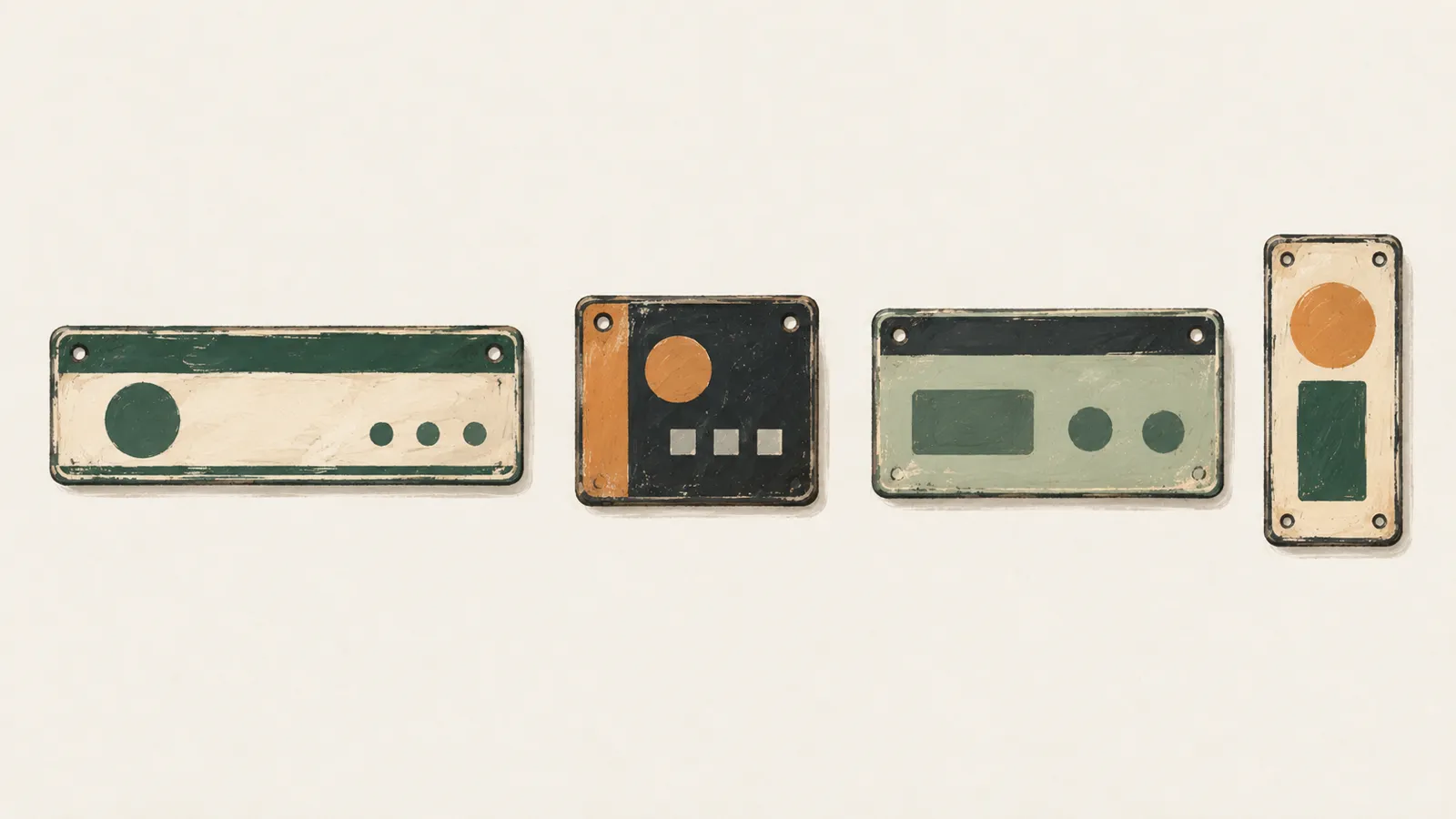
Plate design is national law, so formats differ in shape, colour and structure — the long European strip, North America’s squarer issue, Japan’s green-on-white private-car plates, the UK’s white-front/yellow-rear pairing. Within each system the character pattern often carries information: German plates open with a district code for the registering city or region; UK registrations embed a twice-yearly age marker under the current format; many US states cycle through serial schemes that enthusiasts can date loosely by issue.
That era information has a real use in identification work: a plate format can place a registration — and sometimes the car’s documented life — inside a year band, the same era clue the photo-dating guide uses when the car is the clock. The caution is always the same: format changes arrive on different dates in different places, old plates survive on old cars, and a cherished or transferred registration can make a car look older or newer than it is.
Figure 1 · Format is a fingerprint of the register
What the public can legally check
A few registers publish a deliberately limited slice of the record. The clearest documented example is the UK, where the DVLA’s free vehicle-information service returns, for any registration number: tax and SORN status, MOT status and expiry, the dates it was first registered and its logbook last issued, year of manufacture, type-approval category, weight, engine size, fuel type, CO₂ emissions and an export marker. That is a real lookup — and note what it excludes: no keeper name, no address, no contact route.
Even that public slice has limits worth naming. A DVLA result shows what the register holds — not whether the record is current to the day, not whether the car wears its true registration, and nothing about accidents, finance or keeper history. The history guide covers the checks that do reach those events; a plate lookup is the doorway to them, not the answer itself.
Elsewhere the rules diverge in both directions. Most jurisdictions still expose no general plate lookup at all, and where unofficial “plate search” sites exist they typically resell the small public slice or scrape insurer and listing data rather than opening the register; in the US, federal law restricts disclosure of personal information held in state vehicle records. But restricted is not universal — Norway’s roads authority offers an official keeper lookup by plate, online or by text message, and Finland’s transport agency sells keeper details through a paid, authenticated service whose access can be restricted. Check the country’s own register before assuming a plate is either a directory or a dead end.
Who may look up the keeper
Whether the keeper’s identity is reachable at all is a national design choice. Where access is closed, it is closed on purpose: a plate is displayed to everyone who walks past a parked car, and making it a public directory would hand every observer a lookup into a person’s life. The UK sits at the gated end — DVLA releases registered-keeper details only for a documented “reasonable cause”, such as tracing a vehicle that damaged property or resolving a parking incident on private land, via the appropriate request form; the route is open to anyone who can show that cause, and requests that don’t meet the bar are refused.
Other countries make the opposite call. Norway’s Statens vegvesen lets anyone look up a vehicle’s registered keeper — through an online login or a text message that costs a few kroner — while logging every search for a year. Finland’s Traficom sells owner and holder names plus vehicle history through an authenticated e-service, with disclosure restrictions that can block the personal data entirely. In both cases the lookup is the register’s own service, not a third-party shortcut — and its answer stays thin wherever it’s lawful: the registered keeper is a record field, not proof of who was driving, who uses the car, or whether the record is current.
Plates in photos: sharing vs privacy
A plate in a photograph is a lookup key you’re publishing — which is why this site’s privacy practices treat vehicle images as personal data territory and why the tool identifies the car, never the keeper. When you share a photo, blur or crop plates of cars that aren’t yours: the visible number is lawful to photograph but cheap to abuse, and the internet never forgets a registration.
Keep the unblurred original when the photo is evidence. After a collision, a hit-and-run or a theft, the plate is the single most valuable detail you captured — preserve it unedited for the police report and the insurer, and blur only the copies you share publicly. The incident-reporting guide covers what a partial plate is worth and how to hand it over.
Sources and what they cover
Sources last checked . Registration rules differ by jurisdiction and change over time — the UK, Norwegian and Finnish services cited are the documented examples; check the authority in your country for its current rules.
- Wikipedia: Vehicle registration plate — what plates officially identify, how format and meaning vary by jurisdiction, and the era-information some systems embed.
- GOV.UK: Get vehicle information from DVLA — the UK’s public registration lookup and the exact fields it returns, deliberately excluding keeper identity.
- GOV.UK: Request another vehicle’s registered keeper details — the reasonable-cause gatekeeper that controls release of keeper information in the UK.
- Statens vegvesen (Norway): Find the owner of the vehicle — Norway’s official keeper lookup, available online or by text message with every search logged; the open-register end of the spectrum.
- Traficom (Finland): Check vehicle information — Finland’s official vehicle-information service, where owner and holder names and vehicle history are provided for a fee to authenticated users, subject to disclosure restrictions.
Spotted an error? Tell us — include the page address and what looks wrong.