In short
Call the police first — emergency services if anyone is hurt — and never chase or confront the other driver. Give what you actually saw: colour, make and model if known, any plate fragment, direction of travel, damage and distinguishing marks, and say plainly what you didn’t catch. A photo or an AI suggestion is one more lead to hand over, clearly labelled as such — it is not an identification, and it is not evidence of who was driving.
Safety and police first
Before any vehicle details, two rules outweigh everything else on this page:
- People first. If anyone is hurt, call emergency services before anything else — and get yourself somewhere safe before you make any calls or take any photos.
- Never pursue or confront. Do not chase a departing vehicle and do not approach a driver who may return. Your job as a witness ends at observing and reporting; everything else belongs to police.
Call from the scene if it is safe to. ICBC’s hit-and-run guidance asks witnesses to phone the police right away — from the scene where possible — and to record the plate, the vehicle description, where and when it happened, and what the driver looked like if seen. Procedures and numbers differ by country; the constant is that police and your insurer each hear about it promptly — two separate reports on their own clocks, not one a prerequisite for the other.
The details police actually use
Police forces build vehicle descriptions from a stable set of fields. The Sacramento Police Department’s vehicle description form is a public example — it asks a witness for colour, year, make, model, licence plate and its issuing state, direction of travel, time elapsed since sighting, bumper stickers, body damage, tinted windows and unique characteristics. Georgia’s crash-reporting manual has officers capture the same family of details — colour and body style from witnesses — and log evidence left at the scene, such as paint transfers and broken plastic pieces.
Notice what is not on that list: nobody expects you to name the exact trim or recite a full plate. A useful description is honest coverage of the ordinary fields, delivered quickly. Work through them in order: colour first (it survives distance best), then body style, then make and model if you know them, then whatever plate fragment exists.
Figure 1 · What a witness description covers
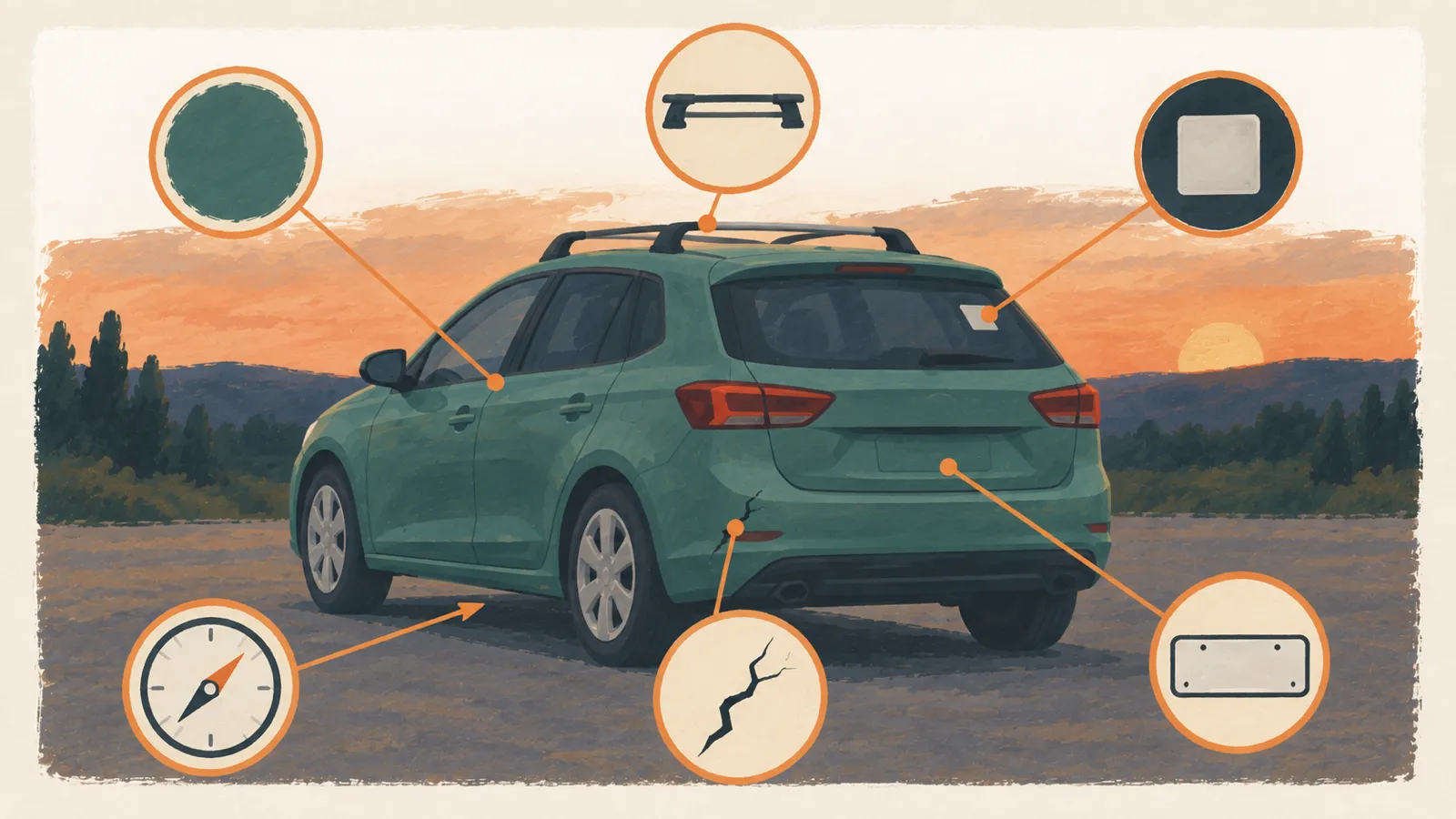
Colour, direction, damage, distinguishing marks
Colour is the first field and the most forgiving — report what you saw, with the confidence you have: “dark blue, maybe grey” is better than a confident wrong answer. Direction of travel and time elapsed are what turn a description into a search area; even “towards the motorway, two minutes ago” narrows where police look.
Damage and marks are the discriminating layer, the details that separate this car from every other silver hatchback:
- Fresh damage — which corner, what kind (crumpled, scraped, cracked lamp), and what it will look like when found.
- Existing marks — mismatched panels, rust patches, a different-coloured door.
- Add-ons — roof racks, bull bars, tow bars, bike racks, aftermarket wheels, window tints.
- Stickers and clutter — bumper stickers, badges, sunshades, a child seat visible inside.
If debris was left behind — paint transfer, trim pieces, a lamp lens — mention it and point it out rather than collecting it; Georgia’s crash manual notes officers document exactly this kind of scene evidence.
Partial plates and uncertainty
A partial plate is still evidence. The Sacramento form separates the plate from its issuing state because a fragment plus a region still narrows a search enormously — report letters or digits in the order you saw them, flagged as partial. The plates guide explains what a registration can and cannot reveal, and why who may look up the keeper depends on the country — gated behind reasonable cause in some places, an official public service in others. Any specific claim is more useful tagged with confidence: “the last three looked like 8-2-something” beats a reconstructed guess.
The form’s own guidance is the rule for the whole description: give what you know and say so when you don’t — inaccurate information misdirects the response. Uncertainty is not a failure. “I didn’t see the driver,” “it might have been a wagon, not a hatch,” and “I can’t swear it was a 2010s car” are all reports police can use. A confident wrong answer is the only kind that hurts.
What a photo ID can add — and its limits
A dashcam still or a phone photo is the strongest witness memory aid — but handle it as evidence, not as content. Hand over the original file, exactly as the camera wrote it: do not crop, enlarge, enhance or filter the only copy before police have it, because the discarded pixels may contain the detail that later matters. The partial-photo guide covers what degraded images can and cannot support.
An AI-assisted suggestion belongs in the same envelope: running the photo through Car Says Hi may return a possible-model suggestion worth mentioning alongside your observations — as a lead for police to weigh, labelled as a tool output. It is not an identification, it cannot say who was driving, and it is not evidence. If you submit a photo, the privacy policy explains how uploads are handled.
After the report: insurer and records
Police report and insurance claim are separate tracks, each with its own clock. In British Columbia, ICBC asks for a police report when there is a suspect or an injury — within 24 hours where possible — while the insurance claim itself should be reported as soon as you can, and no later than six months after the incident. You do not need a finished police report before telling your insurer; other provinces, states and policies set their own deadlines, so read your own card and policy rather than this paragraph for dates. Keep the police report reference number with your claim once you have it.
Two practical rules carry across markets. First, don’t wash or repair the vehicle before the insurer or police have recorded the damage — the scene of the crime may be your own paintwork. Second, if a vehicle is later identified, the original report can be supplemented: Georgia’s manual notes that hit-and-run reports get updated when the driver is found. Your early description is what that supplement attaches to, so accuracy then pays later.
Sources and what they cover
Sources last checked . These are jurisdiction-specific public documents used as examples of practice — none replaces your local police or insurer’s instructions.
- Sacramento Police Department — Suspect/Vehicle Description Form (PDF) — the witness fields police use: colour, year, make, model, plate and issuing state, direction, elapsed time, damage, stickers, tint and unique characteristics, plus explicit guidance against guessing.
- Georgia DOT — Crash Reporting Manual, Hit and Run topic — how officers document colour and body style from witnesses, scene evidence like paint transfers and debris, and report supplementation when a driver is later identified.
- ICBC — Hit-and-run claims — call police first (from the scene where possible), what to record, prompt claim reporting and the advice not to repair before damage is documented. British Columbia, Canada.
Spotted an error? Tell us — include the page address and what looks wrong.