In short
Read a car photo the way spotters do: body shape first, then the face, then the rear and badges, then the small fittings. Each step narrows the field. A photo can suggest a make, model and rough year; it cannot confirm one vehicle’s condition, history or authenticity.
Start with the silhouette and body style
Before any badge or lamp, the outline does the most work. Count the volumes: does the car have a separate boot (a three-box sedan), or does the roof run to the tailgate in one slope (a two-box hatchback or wagon)? How tall is it, where does the roofline peak, and how long is the bonnet relative to the cabin?
Body style narrows thousands of models into a handful of families. A car that reads as a hatchback cannot be a sedan-only model line; a tall two-box shape with roof rails points at crossovers and SUVs. The body-style glossary defines each shape if the vocabulary is new.
Figure 1 · Broad shapes first
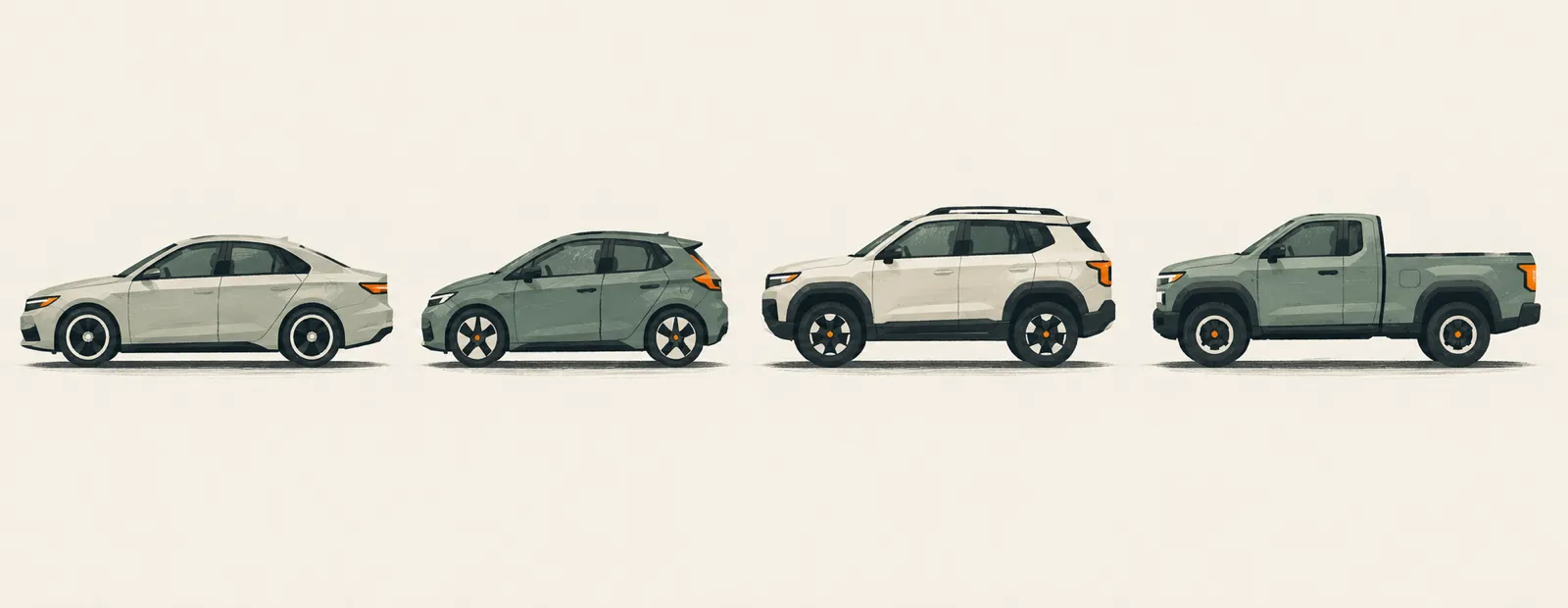
Once the broad shape is set, note proportions: a long, low hood with the cabin pushed back suggests a performance layout; a short nose with a tall cabin suggests space efficiency. Proportion is era-sensitive too, and it is the fastest way to separate a 1990s saloon from a modern one at a glance.
Most photos are not taken for identification, so expect the frame to hide part of the answer. A listing screenshot crops the tail; a street shot hides the face behind traffic. Work with what survives: the silhouette and roofline are visible in almost any crop, so lock those in first, then use whatever fragment of the face or rear remains rather than guessing at the hidden areas.
Read the face: grille, lights, bumper
The front end carries the most brand-specific design language. Makers repeat a “face” across a range: grille outline, headlamp shape and how the two meet, daytime-running-light signature, and the shape of the lower bumper openings. Learn a brand’s current face and whole model years become recognisable.
- Grille outline: a frame shape is hard to disguise. Split kidneys, a single trapezoid, a wide mesh panel or a sealed blank all point at particular makers.
- Headlight outline: lamp shape and how it wraps into the wing varies by model and generation, and it changes reliably at redesigns.
- Bumper openings: the size and position of intakes, fog lamps and sensors help separate trims and model years within one design.
Vehicle-recognition research treats viewpoint as a major difficulty: the same car presents a different image front-on versus in profile, and resolution, motion blur, lighting and occlusion all change what is visible. Read more in the Vehicle Re-Identification in Context study. In practice, a three-quarter view that shows the face and one side is the single most informative angle — the photo tips guide covers how to capture it.
Check the rear and any badging
The rear often settles what the front left open. Tail-lamp outlines and whether they extend onto the tailgate, the shape of the rear screen, exhaust count and position, and the number-plate recess all differ between models that share a face. Light bars spanning the tailgate’s width, exposed spare wheels and roof-mounted aerials are equally telling where they appear.
Badges can name the answer outright. Marque on the grille or boot, model and sometimes engine or drivetrain on the tailgate — but treat a badge as a claim, not proof. Badges are swapped, removed and faked; the badge guide covers what they mean and when they mislead. If a badge is legible, still check it against the car’s shape: a nameplate on the wrong body is a red flag for a swapped badge, not a shortcut to an answer.
Wheels, mirrors and small details
Once two or three candidates remain, the small fittings separate them. Wheel designs are usually trim- and year-specific; mirror housings, door handles, side repeaters, roof rails and window-line chrome differ between versions that share bodywork. Note them, but weigh them lightly, since wheels and trim are the parts owners most often change.
Keep a shortlist rather than a single guess. Write down what each visible detail rules in or out; a confident wrong answer is worse than two honest candidates. If your candidates are different generations of one model, the generations and facelifts guide explains how lamps and bumpers shift within a single nameplate.
If you can take a second photo, change angle rather than zoom. A straight-on front or rear view plus a close shot of the wheels and badges answers more questions than a tighter crop of the same corner — the face and tail carry different evidence, and the AI check works best when it can see one of them clearly.
What a photo cannot confirm
However clear the image, a photo suggests an identity; it does not verify an individual vehicle. It cannot confirm:
- Condition or roadworthiness — rust under fresh paint, accident repairs and mechanical state do not show in a three-quarter view.
- History — ownership, mileage, outstanding finance, write-off or theft records live in official records, not in the image.
- Authenticity — a car can wear another model’s badges, panels or even a cloned identity.
- Exact specification — trim, options and engine often need the identifier on the vehicle, not the picture of it.
From a likely name to a record check
Once you have a likely make, model and rough year, move from pictures to identifiers. The vehicle identification number (VIN) is the bridge: Consumer Reports’ VIN guide explains what each position encodes, and the US NHTSA vPIC decoder turns a US-market VIN into manufacturer-reported fields such as make, model, model year and body class.
Compare the decoded record against the car and its paperwork before treating the name as settled — the model, year and trim cross-check walks through that comparison and its limits. Outside the US, the registration document and the manufacturer’s own records play the same bridging role; the principle is identical — the identifier on the car outranks its picture. When the photo does its job, the record check confirms it; when they disagree, the records win.
Sources and what they cover
Sources last checked . Linked sources support the general claims beside them; none of them measures Car Says Hi’s own accuracy.
- Vehicle Re-Identification in Context (Kanacı, Zhu and Gong, 2018) — how resolution, motion blur, illumination, occlusion and viewpoint change a vehicle’s appearance in images.
- NHTSA vPIC VIN decoder — manufacturer-reported fields for US-market vehicles, model years 1981 onward.
- Consumer Reports: what a VIN tells you — what each VIN position encodes, including build plant and year.
Spotted an error? Tell us — include the page address and what looks wrong.