In short
Car models are redesigned every few years (a new generation) and refreshed in between (a facelift), so one name covers several visibly different cars. Model year, build year and registration year are three different dates. A clear photo can suggest the generation and its production period — the exact year needs the VIN or build records.
What a generation is
Manufacturers keep a model name running while replacing the car beneath it. A generation is one of those wholesale redesigns: new platform, new body, new interior, usually every five to eight years. Enthusiasts refer to them by internal codes — a VW Golf Mk5, a Honda Civic’s tenth generation — and spotting guides rely on the same idea.
Between redesigns, the nameplate keeps its identity but the body panels, lamps, interior and even engine range change. That is why “it’s a Golf” can be true for a 2004 car and a 2019 car that share almost no visible parts, and why a photo can usually place a car inside one generation long before it can settle a year.
Enthusiast vocabulary names generations by ordinal (“Mk5”) or by the maker’s internal chassis code — an E46 BMW 3 Series, a W211 Mercedes E-Class. A result or a forum post that quotes a code is giving you the same generation information in shorthand, and searching the code plus “facelift” or “pre-facelift” usually surfaces the visual differences directly.
What a facelift changes — and what it keeps
Midway through a generation, most models get a facelift — also called a mid-cycle refresh or update. The recipe is consistent enough to learn: Wikipedia’s automotive facelift entry describes it as revisions to a car’s styling during production — typically new bumpers, lights, grille and trim, sometimes updated interior technology, and occasionally mechanical changes — while the fundamental body structure carries over.
Figure 1 · One model, two faces
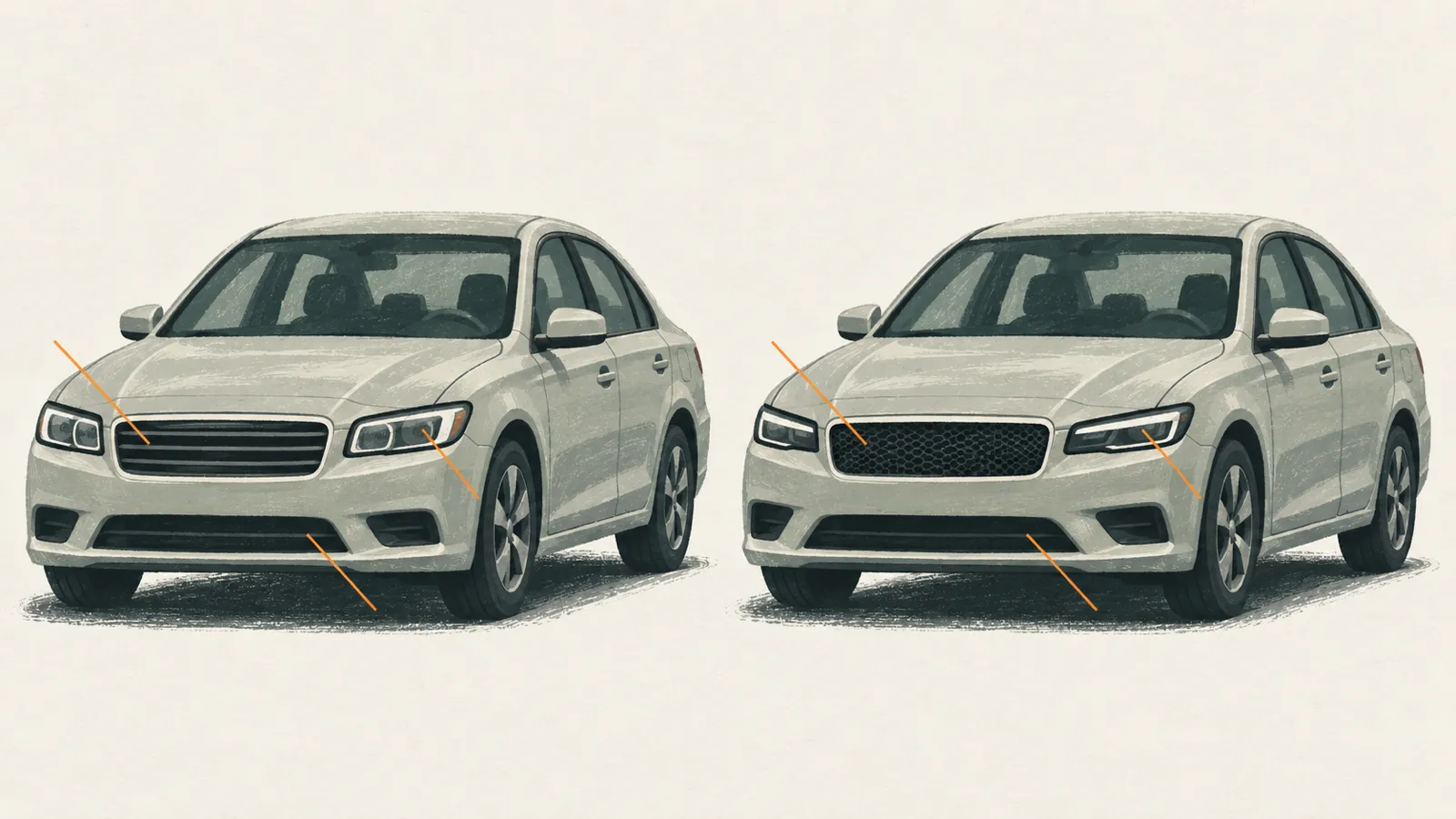
The useful discipline is asking what a facelift cannot change cheaply: glasshouse shape, door pressings, roofline and overall proportion. If two cars differ in those, you are looking at different generations, not a refresh. If they differ only in lamps, grille and bumper, they are likely the same generation either side of one.
Refreshes occasionally land mechanical changes too — a revised engine option, new infotainment hardware, updated driver-assistance sensors — which is why “same generation” does not always mean “same parts” or “same equipment”.
Overlap is real, too — as one parts supplier’s examples show, the same model year can be sold with old-style or new-style fittings during a transition, which is why trim level and build date matter for parts questions.
Model year vs build year vs registration year
Three dates get shortened to “the year” in conversation, and they routinely disagree on the same car:
Figure 2 · Which “year” do you mean?
A concrete case: a car built in December 2021, marketed in the US as a “2022 model”, and first registered in January 2022 carries all three answers correctly. A listing that mixes the fields is sloppy rather than necessarily dishonest — check which date each document actually states before treating a mismatch as a problem.
A year range describes a generation’s production period, not an individual car. Treat any year a result names as a provisional hint to check against the records below — and when a document states a year, check which kind it is before calling it a contradiction.
Where generational clues live
To tell two looks of one nameplate apart, read the parts a facelift changes:
- Lamps: headlight and tail-light outlines, LED signatures and light bars shift at every refresh.
- Grille and bumper openings: the fastest “pre- vs post-facelift” tell on the front end.
- Interior screens: infotainment size and dashboard layout often update mid-generation even when sheet metal stays put.
- Badges and trim: new typefaces, blacked-out emblems and renamed trims track the refresh, though badges alone can lie, as the badge guide explains.
- Wheel designs: alloy patterns are restyled at most refreshes — a strong supporting clue, but also the part owners change most easily.
Why photos give a year range, not a year
Nothing in a photo carries a date. A reader — human or AI — matches the visible design to the years that design was sold, and designs span multiple model years with mid-cycle sub-variants. An answer like “2018–2021” is the honest output of that match: the precision the picture can support is a range.
Timing adds a second layer of imprecision: the same generation can launch in different calendar years in different markets, and markets phase in facelifts months apart. A car that reads as “the 2019 look” in one country may genuinely be a 2020 elsewhere — another reason a range, anchored to the visible design, beats a single guessed year.
Pushing past that precision invents certainty the evidence doesn’t hold. If a car sits inside a facelift window, built while old and new fittings overlapped, the photo may support even less. A range is also what makes a shortlist workable: two adjacent generations of one model are easier to tell apart than two trims of a single year, so the band narrows the search without overselling it. When a narrower year matters for buying or parts, move from the picture to the identifier.
Pinning the exact year with records
The VIN settles what appearance can’t. For US-market vehicles, the NHTSA vPIC decoder returns manufacturer-reported fields including the model year, and the VIN’s tenth position encodes the model year for vehicles built since 1981 — not the build date. The certification label in the door jamb records the month and year of manufacture, and the registration document adds the registration date alongside.
Outside the US, the equivalent is the registration document plus the maker or dealer reading the VIN against their own records — many markets also record the year of manufacture separately from the first registration date, which is why a single “year” field can hide the same three-way split.
Decoder output confirms the headline fields, but trim and option-level detail sometimes lives only in the manufacturer’s own records, where a dealer or the maker’s archive can read the build sheet when the public fields run out. For anything structural — ordering parts, checking recalls, confirming what a seller claims — use those records rather than the look. The model, year and trim cross-check walks through comparing them, and the recall guide covers the safety-record check that follows.
Sources and what they cover
Sources last checked . Linked sources support the general claims beside them; facelift timing and naming vary by maker and market.
- Facelift (automotive) — Wikipedia — what a mid-cycle facelift typically changes: front fascia, lamps, bumpers, interior and sometimes mechanicals.
- NHTSA vPIC VIN decoder — manufacturer-reported model year and build details for US-market VINs.
- 49 CFR 565.15 — US VIN content requirements — the VIN’s year field is the model year.
- 49 CFR 567.4 — US certification label — the door-jamb label records the month and year of manufacture.
- Parts Nation: new vs old body styles — worked examples of old-style and new-style fittings overlapping within one model year.
Spotted an error? Tell us — include the page address and what looks wrong.