In short
Most cars fit eight shapes: sedan, hatchback, estate, SUV, coupé, convertible, van and pickup. The quickest sort is counting volumes — one box, two boxes, three. Names differ by country, and a body style narrows the field without ever naming a specific car.
The main shapes at a glance
Body style is the first question in any identification: it shrinks thousands of models into one family before you look at a single badge. These are the terms this site’s guides and result cards use.
Figure 1 · The eight common shapes
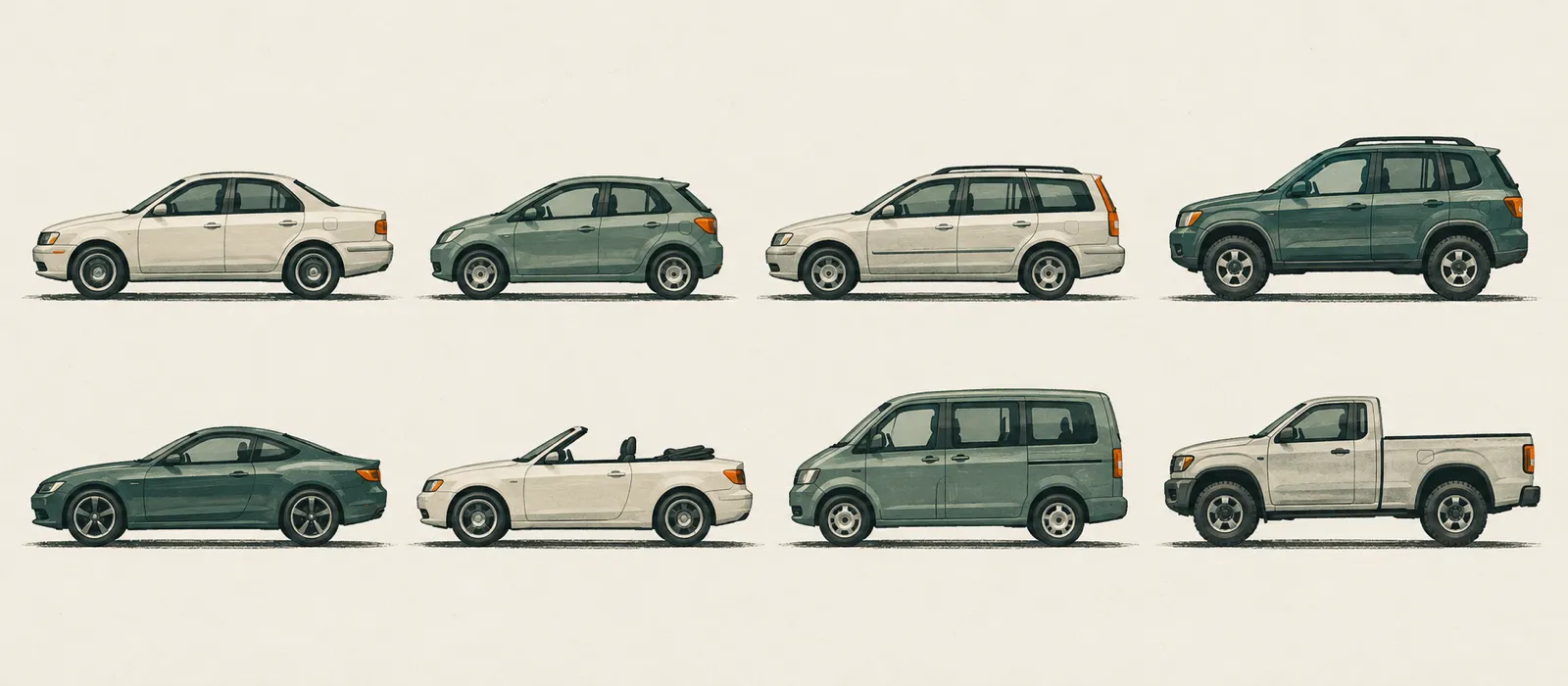
- Sedan / saloon
- Three clear volumes (engine bay, cabin, boot) with a separate boot lid. Called a saloon in the UK; the classic family-car shape.
- Hatchback
- Two volumes with a rear screen that lifts with the tailgate as one hatch. The default small-car layout in Europe and Asia.
- Estate / wagon
- A hatchback family member with the roof carried to the tail and a boxier load space. “Wagon” and “station wagon” are the North American names.
- SUV / crossover
- Tall two-box body with raised ride height. “SUV” traditionally meant a separate chassis; “crossover” describes the same silhouette built on car underpinnings, though the terms blur in everyday use.
- Coupé
- A fixed-roof car with a sloping rear, usually two doors. Makers now stretch the label onto sleeker four-doors, so treat it as a roofline description first.
- Convertible / cabriolet
- A car whose roof folds or detaches — soft-top or folding hard-top. Roadster and spyder name the two-seat kind.
- Van / MPV / minivan
- A tall, box-led body maximising interior volume. Cargo versions are panel vans; people-carrying versions are MPVs (Europe) or minivans (North America).
- Pickup / ute
- A cabin plus a separate open load bed. “Ute” covers the car-derived Australian version as well as larger pickups.
Two-box vs three-box thinking
The oldest split in body vocabulary counts the “boxes” a car’s profile makes. A three-box car shows engine bay, cabin and boot as three distinct volumes: a sedan or classic coupé. A two-box merges cabin and load area under one roof that ends at a shared tailgate, as in hatchbacks, estates, SUVs and most vans. A one-box runs everything under a single arch, like a small van or people-mover.
The split sounds academic but is genuinely useful: from a distance, a two-box with a long roof is an estate while a two-box with a short one is a hatchback, and no three-box sedan can be mistaken for either. Wikipedia’s car-classification article maps how these terms shift between markets — a “wagon”, “estate”, “touring” and “shooting brake” can describe near-identical shapes depending on who is speaking.
SUVs and crossovers
The hardest modern pair to separate is SUV versus crossover, mostly because the marketing difference outgrew the mechanical one. A traditional SUV is body-on-frame with off-road intent; a crossover applies the tall two-box silhouette to a car’s unibody platform. In a photo, both read the same way: raised ride height, taller beltline, roof rails, cladding.
Official labels do not settle it either. The US EPA fuel-economy label sorts vehicles into market categories such as “Small SUV”, “Station Wagon” and “Pickup Truck” — nine car categories plus six truck categories — and states they exist for labelling and consumer information, not as a formal taxonomy. Use “SUV” as a visual family name, then let the maker’s own classification settle arguments.
Ride height and stance are the practical field marks when a badge says one thing and the shape suggests another: a crossover sits like a tall car over its wheels, while a body-on-frame SUV stands visibly higher off the ground and often shows running boards or a deeper sidewall.
Estates, liftbacks and fastbacks
Three rooflines that are easy to confuse from behind:
- Estate / wagon: the roof stays high to the very back, ending in an upright tailgate. It keeps a sedan’s length but swaps the boot for a tall box.
- Liftback: looks like a sedan in profile but the whole rear, screen included, lifts as a hatch. The giveaway is the shutline around the rear screen, not the silhouette.
- Fastback: describes the roofline, not the opening: one continuous slope from roof to tail. A fastback can be a liftback in function or a fixed-boot sedan underneath.
When a result calls a car a “liftback” or “fastback”, check where the rear screen ends and whether it moves with the tailgate — that is what separates label from label.
Vans, utes and pickups
Vans trade style for volume: a tall, upright body where the cabin and cargo space share one form. Passenger versions wear MPV or minivan names and gain windows and seats; panel vans blank the rear glass for cargo.
Pickups keep the cabin and cargo apart — a fixed cab with an open bed behind. Australia’s “ute” historically meant a car-derived pickup built on a sedan platform, though the word now covers larger trucks too. In photos, bed length and cab size (single, extended, double) matter more to identity than the pickup label itself.
Why body style alone doesn’t name the car
Body style is a filter, not an answer. Hundreds of models share each silhouette, and the same nameplate can be offered in several bodies: hatchback, estate and sedan versions of one model often share a nose and nothing else. Regional naming adds noise: the same shape may be a “saloon” in one brochure and a “sedan” in the next.
Maker vocabulary adds a third kind of noise: the same body can be sold under invented style names — “Sportback”, “Gran Turismo”, “Active Tourer” — that map to no universal definition. Treat those as trim-level marketing words and classify by the silhouette, not the suffix.
Even within a single name and year, the body details can move; this parts supplier’s comparison shows same-model-year vehicles carrying different grilles, lamps and bumper fittings between old and new styles. Treat “it’s a hatchback” as step one of an identification, then work the face, rear and details in the photo reading walkthrough.
Quick self-check
Before you rely on a label, ask:
- How many volumes does the silhouette show — one, two or three?
- Does the rear screen lift with the tailgate, or is there a separate boot lid?
- Is the roofline flat to the tail (estate) or does it slope away early (fastback/liftback)?
- Is the load area enclosed and tall (van), open (pickup), or part of the cabin (hatch/SUV)?
- Whose vocabulary is this — does the seller’s market use estate, wagon or touring for the same car?
Sources and what they cover
Sources last checked . Linked sources support the general claims beside them; body-style naming varies by market and maker.
- Car classification (Wikipedia) — definitions of the common body styles and how their names differ between regions.
- US EPA fuel-economy label guide — the market categories used on US window labels (Small SUV, Station Wagon, Pickup Truck) and their limits.
- Parts Nation: new vs old body styles — worked examples of same-name vehicles differing in grille, lamp and bumper details.
Spotted an error? Tell us — include the page address and what looks wrong.