In short
Car Says Hi sends your image or typed name through this site’s Worker to an AI model, then checks the reply against a strict result schema. The model weighs visible clues — shape, face, badges, proportions — and answers with a likely identity plus a qualitative confidence. It is a well-read guess, not an inspection.
What the model actually sees
When you choose “Identify this car”, your browser resizes the photo and sends it to this site’s Worker, which forwards it to the Qomza analysis gateway. An AI model then reads the image much as a patient spotter would. The overall silhouette, the face of the car, badging, wheel design and stance are weighed against the vehicle designs it learned during training. Nothing about the specific vehicle is retrieved: the model has no access to registration records, the photo’s location, or the car’s history.
Figure 1 · From photo to answer
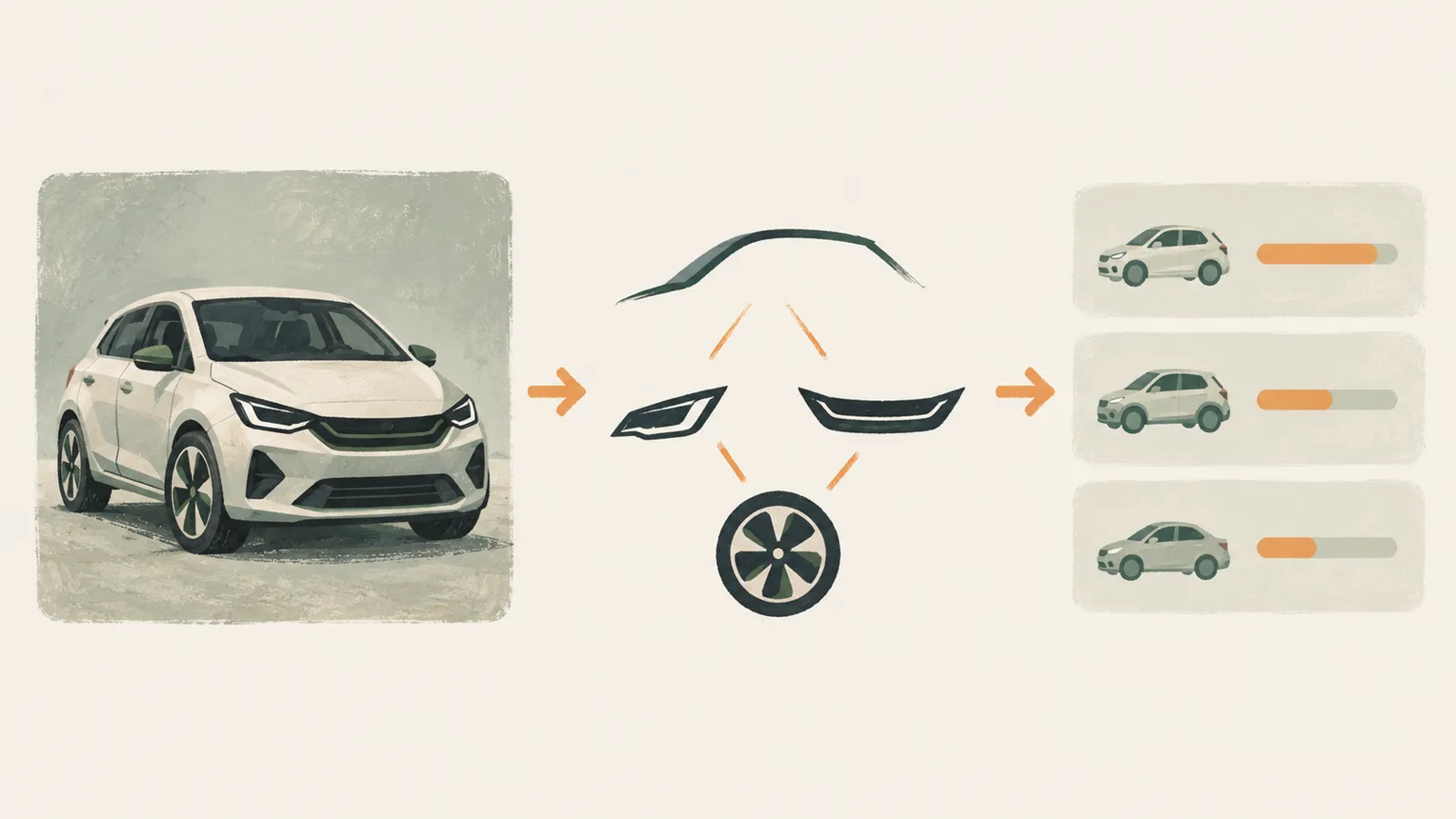
That is also the method’s deep constraint. Academic vehicle re-identification work, which matches the same vehicle across cameras, has long grappled with how resolution, motion blur, lighting, occlusion and viewpoint alter what a model can see; the Vehicle Re-Identification in Context benchmark exists precisely because those variations defeat naive matching. A clean three-quarter photo gives an identifier far more to work with than a rear-only night shot.
Inputs other than a fresh photo take the same path. A listing screenshot is submitted whole as an image — the model sees everything visible in it, including any listing text, which it is instructed to treat as untrusted context rather than fact — and a typed name or description skips identification entirely and goes straight to a model overview.
Why confidence is a label, not a percentage
Car Says Hi never shows an accuracy percentage, because no honest one exists. A model cannot measure how right it is on your photo — it can only report how the evidence compares to patterns it knows. Each label answers a practical question — how much checking does this answer deserve — rather than a statistical one. We translate that into three qualitative labels:
- Good match: the visible evidence lines up strongly with one answer.
- Possible match: a plausible candidate, with meaningful room for error.
- Early clue: a direction to investigate, not a name to rely on.
These describe how well the evidence supports the answer — a judgement, not a calibrated probability. A “Good match” can still be wrong, and an “Early clue” can be right. Read the label as advice about what to do next, not as a score to trust:
- Good match: proceed, but confirm the specific vehicle through documents before a decision that costs money.
- Possible match: compare the candidate against the similar-car suggestions and gather another angle if you can.
- Early clue: the input was thin, so a clearer photo or a typed name narrows the field before you rely on anything.
Where matches go wrong
The failure modes are predictable once you know the method is visual:
- Badges and trim. A swapped or aftermarket badge is the cheapest way to mislead a reader; the badge guide explains when emblems lie.
- Modifications. Body kits, mixed panels and engine-region swaps make a car that no factory catalogue matches.
- Lookalikes. Rebadged twins and related models share bodies across brands, and successive generations of one nameplate can look more alike than rivals do.
- Occlusion and angle. A rear-only crop, a dark frame or a car half-hidden in traffic removes the very features the identification rests on.
- Recall, not reference. The model works from learned patterns; rare models, very new releases and regional variants are the least reliably identified.
- Regional variants. One nameplate can wear different bumpers, lamps and badge positions across markets, and a long-running model accumulates mid-cycle visual changes that blur its profile between years.
When the evidence is thin, the honest answer is the weaker one. A result that names a candidate with caveats is doing more for you than a confident guess — and a wrong answer you catch early is cheaper than a wrong answer you trust.
What else the result contains besides a name
A result card is a starting brief, not a certificate. Alongside the likely identity it can include: the observations the image suggested, general model specifications, model-wide topics worth researching, similar cars to compare, and, only when the model is clearly identified, an AI-generated market estimate with its currency, region and assumptions shown.
Read each part by its own strength. “Common model topics” name what owners and buyers commonly research about that model — reliability patterns, known weaknesses, recall history — and are deliberately worded as prompts to investigate, never as findings about the car in front of you. A market estimate is a broad AI guide, never a quote, appraisal or verified listing range; and no part of a result inspects the individual vehicle’s condition, safety, ownership or history.
The same flow works without a photo: typing a name or description produces a model overview rather than an identification, which is useful for comparing two candidates side by side when the picture couldn’t decide between them.
How to check an uncertain answer
When a result feels wrong, or arrives as a candidate, work outward from the claim:
- Compare the suggested model’s known face and silhouette against your photo using the photo reading walkthrough. If the photo is yours, a second angle — the rear three-quarter in particular — often settles a candidate into a firm answer.
- If the specific vehicle is in front of you, confirm it by identifier rather than appearance: the NHTSA vPIC platform decodes US-market VINs from manufacturer-submitted data, and Consumer Reports’ VIN guide explains what the number encodes.
- Compare the decoded fields against the car and its paperwork — the model, year and trim cross-check walks through that comparison and where it can still leave questions open.
- For anything that will cost money or affect safety, treat the answer as unsettled until paperwork and a qualified inspection agree.
If a result is simply wrong, report it — wrong-match reports are read and help us keep the guides honest.
How our guides are sourced
Each guide on this site is researched against named, authoritative sources — official decoders, government guidance, primary research — linked beside the claims they support and re-checked periodically. When a linked source changes or a reader reports an error, the page is corrected and its sources-checked date updated. The How it works page describes the lookup pipeline, the four result states and the review policy in full, and the Privacy Notice explains what happens to the photos and text you submit.
Sources and what they cover
Sources last checked . Linked sources support the general claims beside them; they are external references, not descriptions of this site’s internals.
- Vehicle Re-Identification in Context (Kanacı, Zhu and Gong, 2018) — research on how resolution, blur, illumination, occlusion and viewpoint challenge vehicle recognition.
- NHTSA vPIC platform — the US vehicle-information catalog and VIN decoder built on manufacturer-submitted data.
- Consumer Reports: what a VIN tells you — what the identifier encodes and where it sits on the vehicle.
Spotted an error? Tell us — include the page address and what looks wrong.