In short
A camouflaged prototype is a car engineered to resist identification: the wrap breaks its silhouette, fake panels fake its proportions, and the finished product may not exist in any database yet. A spy shot can usually support a size class, a stance and a list of possible production siblings — all guesses, labelled as such — and a concept car may identify nothing that will ever be sold. The honest answer to “what is this?” is often “not knowable yet”, and the confirmed name arrives on the manufacturer’s schedule, not ours.
Why prototypes wear camouflage
Testing a new vehicle requires real-world miles — thousands of them, on public roads, in the years before the car is revealed. But the design is a commercial secret until launch, so the car goes out disguised: the goal isn’t to hide that a test car exists, it’s to stop anyone photographing what it will actually look like.
There’s a whole economy on the other side of the disguise. Specialist spy photographers stake out test routes and sell the frames to publications, and manufacturers respond with camouflage coordinators whose full-time job is defeating the lens — a documented arms race between concealment and capture. A wrapped test car isn’t trying to be uninteresting; it’s trying to be unidentifiable, which is a harder job and the reason these photos so reliably stump identification.
Dazzle patterns, fake panels and cladding
The disguise evolves with the programme. Earliest are the mules: powertrain prototypes wearing the bodywork of an existing car, so the engineering can be road-tested while the shape says nothing at all — the industry example is Rolls-Royce developing its SUV’s underpinnings beneath a Phantom shell. Next comes the real structure under foam padding and bolted cladding, built specifically to falsify the proportions: a flat shoulder squared off, a roofline lifted, a hatch disguised as a wagon so the true body can’t be rendered from the spy shot.
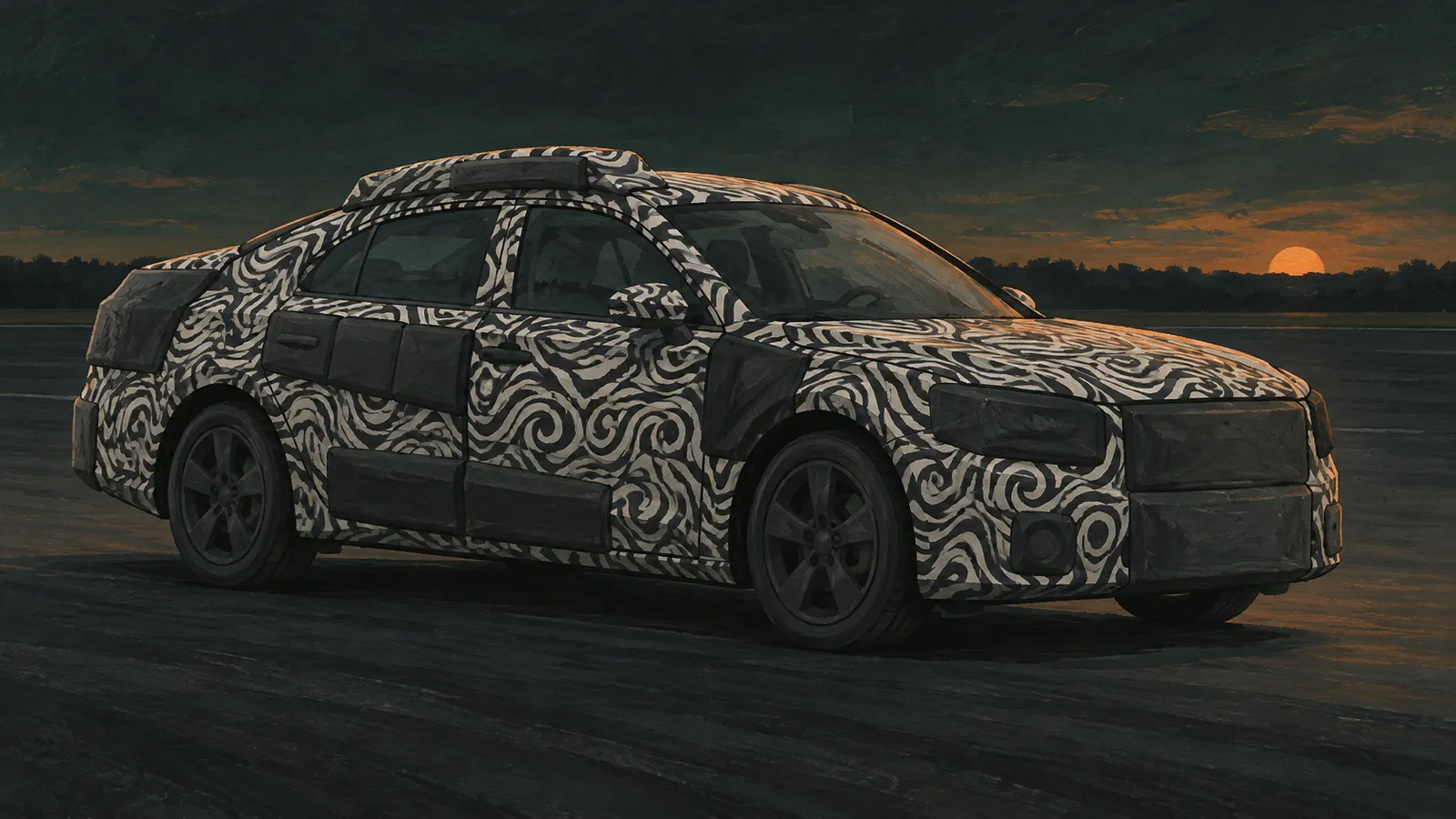
Closest to launch, when bulk would spoil the aerodynamics being tested, the car shrinks into a printed vinyl dazzle wrap: zebra swirls and moiré patterns designed to break up panel lines, flatten depth and trip up both the human eye and camera autofocus. Dummy lamp covers and mesh over the real signatures finish the job. Every layer attacks the same target — the silhouette, surfacing and light signatures that identification reads first.
Figure 1 · A silhouette built to lie
Concept cars vs production intent
The concept car is a different species of unidentified vehicle: a styling or technology statement built for motor-show stands, often to gauge reaction rather than preview a confirmed product. Wikipedia’s definition is precise about the limits — concept cars are never intended to go directly into production; they must undergo changes for practicality, safety, regulatory compliance and cost before a production version could exist.
Between a pure showpiece and a camo’d mule sits the production-intent prototype: a near-final vehicle shown to close the gap between reveal and showroom. The class matters for identification because the answer’s nature changes — a concept may never correspond to a saleable car at all, a production-intent prototype corresponds to a car that exists but isn’t yet on sale, and a test mule corresponds to a car that exists only as engineering. Same puzzle, three different kinds of “answer”.
Reading a spy shot honestly
Camouflage isn’t total — it defeats the surface, not the stance. What usually survives the disguise is the car’s envelope: overall size class, wheelbase and overhangs, ride height and stance, the segment the proportions belong to. Context helps too: where it’s testing, what it’s benchmarking against, whose test track or plates it wears. What the disguise reliably defeats is everything else — the face, the surfacing, the details that separate one sibling from another.
So an honest read of a spy shot is a bounded one: “a mid-size SUV, probably the next generation of that family, final shape unknowable”. Communities that do this well — r/whatisthiscar threads are full of wrapped-test-car posts — treat the answers as exactly that: a shortlist of possibles argued from the envelope and the context, not a name.
A few features escape the wrap because they’re hard to fake: brake hardware visible through the wheels, tyre sizes, mirror housings, the glasshouse’s proportions relative to the body. Test photographers know it, which is why heavy cladding appears exactly over the surfaces that would settle the debate — and why “the camo is thickest at the face” is itself a clue that the face is what changed.
Why IDs here are guesses by definition
Two absences stack against a definitive answer. The unreleased car isn’t in the corpus an identifier learned from — there is no “correct” class to match — and the camouflage was designed to alter precisely the features that would match it. The best an AI read can offer is the nearest production sibling: a guess against what exists, labelled as guesswork, not a name for what’s coming. The AI-identification guide covers the failure modes; this is the only class of input where the failure is intentional.
That means every answer here keeps its qualifier. “Possible sibling of”, “consistent with that maker’s next crossover”, “too disguised to place” — those are the honest outputs. Any answer presented without them has mistaken the disguise for a real car, and the photo-identification guide’s rule applies double: when the frame fights back, a shortlist is the truth.
Where confirmed answers eventually appear
The resolution to a spy-shot mystery arrives on the manufacturer’s schedule: the official reveal, the production photographs, the specification sheet. Concepts get their own afterlife — some evolve toward production models, and the significant ones end up collected: the Petersen Automotive Museum’s Vault, for example, holds prototypes, concepts and one-of-a-kind vehicles as part of the documented record. What was unidentifiable in February is a museum label or a configurator page by autumn.
Until then, the camo car is a puzzle that enjoys being unsolved. Identify the envelope, shortlist the siblings, file it under “ask again at the reveal” — and let the disguise win this round, because that’s what it was built to do.
Sources and what they cover
Sources last checked . Linked sources support the camouflage methods and the concept-car definitions described; no source — and no identification — names an unreleased vehicle as fact.
- CNBC: Camouflage, the incognito way car makers test drive new prototypes — the public-road testing that forces the disguise, mules wearing existing bodywork, foam padding falsifying proportions, and the spy-photography trade the camo is built to beat.
- Wikipedia: Concept car — what concept cars are built to do, why they never go directly into production, and the production-intent prototype class between showpiece and mule.
- Petersen Automotive Museum — the museum collecting prototypes, concepts and one-of-a-kind vehicles, where yesterday’s unidentifiable cars end up documented.
- Reddit: r/whatisthiscar — the community forum where spy shots and camo’d test cars are posted and argued over; the answers are community hypotheses to corroborate, not authorities.
Spotted an error? Tell us — include the page address and what looks wrong.