In short
A classic with no badges and no paperwork still carries its identity in three places: the era its styling belongs to, the serial numbers stamped into its body and chassis, and the reference material marque specialists keep. Read the era to narrow the field, find the stamped numbers to anchor it, and let marque records confirm or kill the hypothesis. A photograph — yours or an AI tool’s — can start that sequence; only the numbers and the archives finish it.
Era first: shape, chrome, lights
Before any number is found, the car’s design already says roughly when it was made. American Collectors’ advice for undocumented cars is to start with physical clues — badges, manufacturer stamps, styling — and use them to point in the right direction rather than to land on an answer. The era is the widest, cheapest filter:
- Prewar (before roughly 1946): separate fenders, running boards, an upright grille, and a narrow, tall body. Cars of this era read as assemblies of parts rather than one shape.
- Late 1940s–1950s: the fenders merge into an integrated “envelope” body; chrome trim grows year by year, and tailfins crest around the end of the decade.
- 1960s: cleaner, slab-sided bodies; many American cars adopt stacked or paired headlamps; ornamentation starts to retreat.
- 1970s–1980s: impact-bumper rules visibly bulk up US-market cars; rectangular sealed-beam lamps spread; trim turns heavier and more plastic.
An era read narrows the search to a shelf, not a shelf-mark — “American, mid-1950s” still covers hundreds of models. That is exactly what the reference books are for: American Collectors points to the Standard Catalog of American Cars and Standard Catalog of Imported Cars, which cover 1945–1990 comprehensively, as the next layer once the era is fixed. The generations and facelifts guide covers how the same model’s face changes year to year, which is what makes era-dating work at all.
Serial and body plates on pre-VIN cars
The 17-character VIN is a modern convention — it was standardised only for the 1981 model year, and the VIN guide covers where modern cars carry it. Older vehicles use maker-specific serial, chassis and body numbers, and finding them is the single most productive step in a no-paperwork identification. American Collectors lists the locations worth checking:
- Windshield VIN plate — visible through the glass at the dashboard edge, but only from the late 1960s onward.
- Door-jamb plate — on the driver’s door pillar or the door itself.
- Firewall or radiator-support stampings — under the bonnet, pressed into sheet metal.
- Chassis rail stampings — on American cars built before 1960, the number is often stamped into the frame rail on the driver’s side, near the seat.
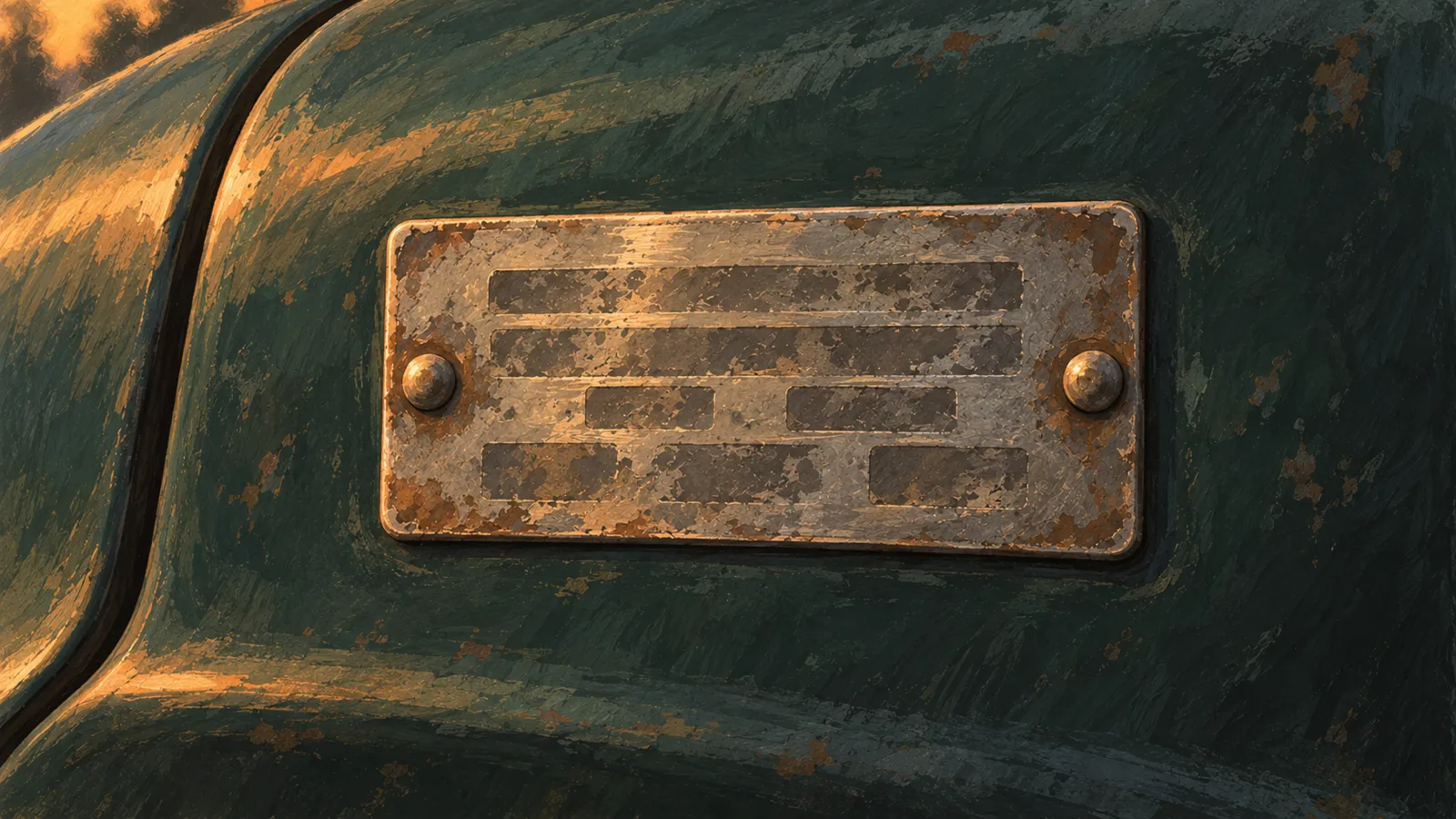
Beneath the bonnet, a second layer of evidence survives on data plates and trim tags: small riveted plates recording the factory paint, interior trim code, body style, build date and engine code. Deeper still, casting numbers on the engine block, transmission and rear axle can corroborate a claimed identity — they are how “matching numbers” claims get checked later. A stamped number, read against the right marque’s records, converts a hunch into a lead with a paper trail.
Figure 1 · Where classics carry their names
Marque references and owner communities
Once the era and any stampings narrow the field, marque-level material does the distinguishing. For prewar cars especially, American Collectors notes that make-specific books — many now published as e-books — may be the only usable references, and that marque owner forums are strong sources provided their confidence is checked: a confident wrong answer is still wrong, so corroborate any forum call against pictures and records before trusting it.
Museums and marque media help at this stage too. The Petersen Automotive Museum publishes documented vehicle spotlights and maintains digital archives covering the breadth of automotive history, and Hagerty’s automotive-history coverage publishes marque and model histories useful for learning what a candidate car should look like. Owner clubs go further: many maintain survivor registries with chassis-number ranges and lists of known cars — the difference between “looks like a 1957 example” and “chassis number falls inside the 1957 run”.
Working this layer is mostly comparison: line the car up against documented photographs of each candidate, and make the details disagree — grille bars, lamp bezels, trim spears, window frames. The candidate that survives the details is the hypothesis worth taking to a specialist.
Modifications that mislead
A car old enough to lose its paperwork is old enough to have lived several lives, and each one can falsify a visual read. Engines move between models and years; grilles, lamps, bumpers and interior trim get transplanted from better-equipped siblings; owners update a car to a later year’s face or replicate a rarer variant. A detail that reads “wrong for the year” may mean the car is modified, not that the hypothesis is wrong — the body and its stampings tell the truer story.
Two traps deserve particular care. Badge work is one: emblems are the easiest thing to swap, and the badge-reading guide covers when they mislead — on a classic, treat every badge as a claim awaiting corroboration. Replicas are the other: tribute cars and kit-built lookalikes carry a famous shape on a different chassis, and only the serial numbers, components and marque records separate them from the genuine article.
From hypothesis to marque expert
When the hypothesis is worth money — or worth proving — the hand-off is to the people who keep the factory’s records. American Collectors lists the documented routes: Ford owners can order a Marti Report; the GM Heritage Center archive reaches back to the 1930s; FCA Historical Services holds build records for 1930–1967; BMW, Porsche, Mercedes-Benz and Volkswagen offer factory validation; the British Motor Industry Heritage Trust issues certificates for ex-British Leyland marques; Ferrari documentation exists but is not cheap; Japanese classics are harder, and the advice is to approach the manufacturer directly.
Auction houses keep research departments and marque specialists with access to material outsiders rarely see — American Collectors notes they may research a car to build the relationship, a route that works best for genuinely valuable vehicles. And where the question is authenticity or valuation rather than identity, the right professional is an appraiser or marque specialist: the market-value guide covers where AI estimates sit relative to that work.
What a photo can never confirm here
A photo is the right way to start — the photo-identification guide covers the reading order — but classics are the hardest case for image-based identification. Training coverage thins out on rare old cars, and American Collectors cautions that AI tools are spotty on older vehicles for exactly that reason: an answer that arrives with confidence can still be confidently wrong, so verify it by pulling up photographs of the claimed car and making the details argue.
Even a correct photo answer stays a hypothesis. It cannot establish authenticity, matching numbers, originality, provenance or value — those live in the stampings, the factory records and a specialist’s inspection, not in the visible surface. A likely identity is the doorway to those checks, never a substitute for them.
Sources and what they cover
Sources last checked . Linked sources support the specific steps and locations described; they are reference material, not an appraisal of any car.
- American Collectors Insurance: How to Identify a Classic Car Without Any Paperwork — the serial and data-plate locations, reference books, marque forums, factory documentation services and the caution about AI tools on older vehicles.
- Petersen Automotive Museum — museum vehicle spotlights and digital archives used as documented marque reference material.
- Hagerty: Automotive history — marque and model history coverage for comparing a candidate car against documented examples.
Spotted an error? Tell us — include the page address and what looks wrong.